Drunkenness
The Canterbury TalesDrunkenness is depicted as a condition that turns appetite into moral disorder and leaves its effects visible in both private conduct and public violence. The narrative links wine with lechery and gluttony, showing intoxication as a force that weakens judgment, exposes secrets, and can make a person commit or authorize acts otherwise unthinkable. Its significance lies in this double damage: drunkenness deforms the individual body and mind while also corrupting relationships, households, and political decisions.
Definition and Moral Logic
The account places drunkenness within a chain of mutually reinforcing vices. Wine is described as a kindler of lechery, while lechery itself goes hand in hand with gluttony. The point is not merely that drinking may accompany other excesses; intoxication actively lowers the barriers that keep appetite under moral control. The drinker is therefore shown as vulnerable to a wider economy of indulgence in which the pursuit of pleasure becomes self-consuming.
This moral logic is reinforced by an appeal to Christian authority. The narrator invokes God’s Holy Writ as witness that lechery is found in wine and drunkenness. Drunkenness thus receives a scriptural rather than merely personal diagnosis: it is treated as a condition whose dangers have already been demonstrated in sacred history. The appeal gives the warning the force of a moral exemplum, converting individual incidents into evidence of a general human tendency.
Biblical Examples of Intoxication
The first major example is Lot. Drunk and unconscious of what he was doing, he lay with both of his daughters. The episode makes impaired awareness central to the meaning of intoxication. Drunkenness does not simply lead a person to choose badly while remaining fully alert; it can suspend consciousness of the deed itself, producing an act whose gravity survives the drinker’s inability to recognize it at the time.
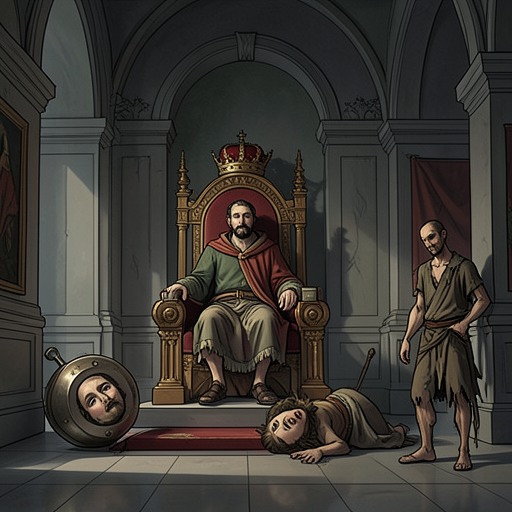
King Herod supplies a contrasting but equally severe example. After drinking heavily at a feast, he ordered the killing of John the Baptist at the table. Unlike Lot’s unconscious transgression, Herod’s drunkenness operates through public authority and impulsive command. The feast becomes the setting for a fatal reversal: convivial abundance and wine-swollen confidence culminate in the death of an innocent man. The example shows that intoxication can magnify the consequences of power, turning a moment of festivity into an occasion of political violence.
Together, the two examples define a broad range of danger. Lot’s drunkenness destroys the boundaries of kinship and sexual restraint; Herod’s transforms a ruler’s speech into an instrument of execution. One case emphasizes unconscious action, the other reckless decision, but both show responsibility being damaged by drink and the resulting harm falling upon others as well as the drinker.
Bodily and Intellectual Collapse
The warning then turns from exemplary history to the physical appearance of the drunk person. The intoxicated body is imagined as falling like a stricken swine. The image strips away dignity and self-command: drunkenness makes the human figure resemble an animal overwhelmed by force. The loss is not only visual. The drunk person’s tongue is lost, and self-respect has been surrendered to the drink.
The deepest injury is described as an assault on discretion and intelligence. Once drink takes dominance, the person can no longer preserve the faculties by which conduct is measured, speech is controlled, and consequences are anticipated. Drunkenness is therefore called the very grave of human discretion and intelligence. The metaphor of the grave makes intoxication a living form of burial: the person remains physically present, yet the capacities that make deliberate human action possible have been covered over.
This condition also carries a social danger because an intoxicated person cannot reliably keep a secret. Speech becomes porous, and what ought to remain guarded may be released without foresight. Drunkenness consequently threatens not only private dignity but also trust between people. A warning to avoid both white and red wine, including white wine bought at Lepe, gives the moral instruction a concrete, practical edge: the danger is attached to ordinary drinking habits and particular varieties of wine, not to an abstract vice remote from daily life.
Social Consequences and Narrative Function
The wider narrative connects drunkenness with the behavior of the summoner, a figure who is also presented as a thief and pimp. He is associated with the image of Judas carrying a little purse to fill, and with taking more than his master was due. His retinue includes women who lure men to bed, placing sexual exploitation, financial appetite, and institutional corruption in the same moral field as drunken excess.
That association clarifies how drunkenness functions beyond the body of the individual drinker. The vice belongs to a culture of appetite in which money, wine, sexual access, and power circulate together. A feast can become the scene of a royal killing; a purse can become the emblem of theft; a drinking habit can loosen the tongue and weaken the boundaries that protect others. The repeated movement from bodily pleasure to social injury gives drunkenness structural importance in the moral portrait of corrupt conduct.
The text’s treatment is also marked by contrast. Drinking appears connected with feasting, ale, and the filling of purses, all signs of abundance and immediate pleasure. Yet the apparent prosperity of the feast conceals collapse: appetite leads to lechery, intoxication to unconscious wrongdoing or murderous command, and pleasure to the loss of intelligence and self-respect. Drunkenness is therefore not simply one vice among many but a catalyst that allows other vices to become active, visible, and destructive.